
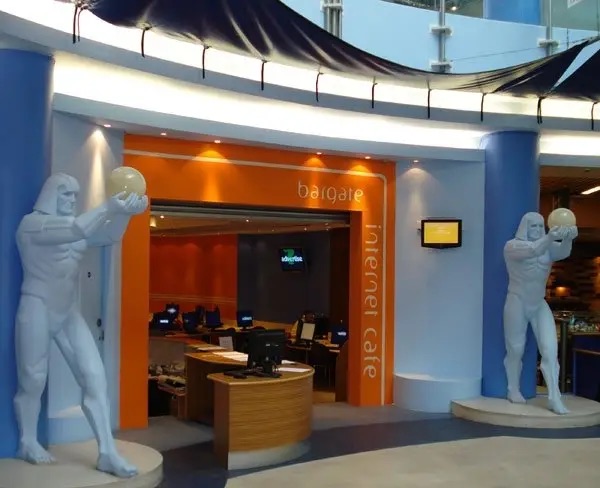
In 2001, I entered Southampton City Youth Service through a New Deal placement with Hype Magazine, a youth magazine then based inside the Bargate Internet Café. I remained within the service until 2005. At that time, it was led by George Davidson, with Steve Fish as deputy, and its main base was in French Street. My own route into the work, however, began in the café.
Hype did not operate from a separate office. Those of us working through New Deal placements were based within the café itself, alongside Youthnet and city-centre youth workers. It functioned as a shared hub in which publishing, digital access, employment experience and informal youth work occupied the same space.
Its location in the middle of Southampton mattered. Young people could enter because they wanted to use a computer rather than because they had been referred to a specialist service. Once inside, they could meet people, spend time and become connected to projects and other opportunities.
At the beginning of the 2000s, access to the internet was still tied to particular places and pieces of equipment. Smartphones did not exist, and reliable access at home could not be assumed. The café therefore offered more than technology: it provided entry into an emerging digital culture while creating a physical meeting place around it.
A place to enter
The internet café was on the upper level of the Bargate Centre. Its entrance was framed by two monumental stone Sun Gods, one on either side, each holding a globe light. The figures formed part of the Centre’s original decorative scheme, which also included sculptures of the Egyptian goddess Isis elsewhere in the building.
By the time I worked there, the globe-bearing figures framed a different form of global access. What had begun as part of the Centre’s retail spectacle, the world represented through themed interiors and monumental décor, had become a place where young people could enter the World Wide Web. The symbolism now feels almost too exact: the world held in their hands, while access to it still depended upon a shared building, equipment, registration systems and the people maintaining the space.
Young people used the computers to communicate, play, write, make images and work on projects. Some arrived with a particular purpose; others stayed because the café offered somewhere to be. Technology provided a reason to enter, but the youth work often happened through the conversations, relationships and unexpected activity that developed around it.
Youthnet: a network of places
Before social media became an ordinary part of daily life, accessing the internet often meant going somewhere. Youthnet can now be mistaken for simply an early website, but it was closer to a small civic infrastructure. It connected internet access with youth centres, publishing, information and opportunities for participation.

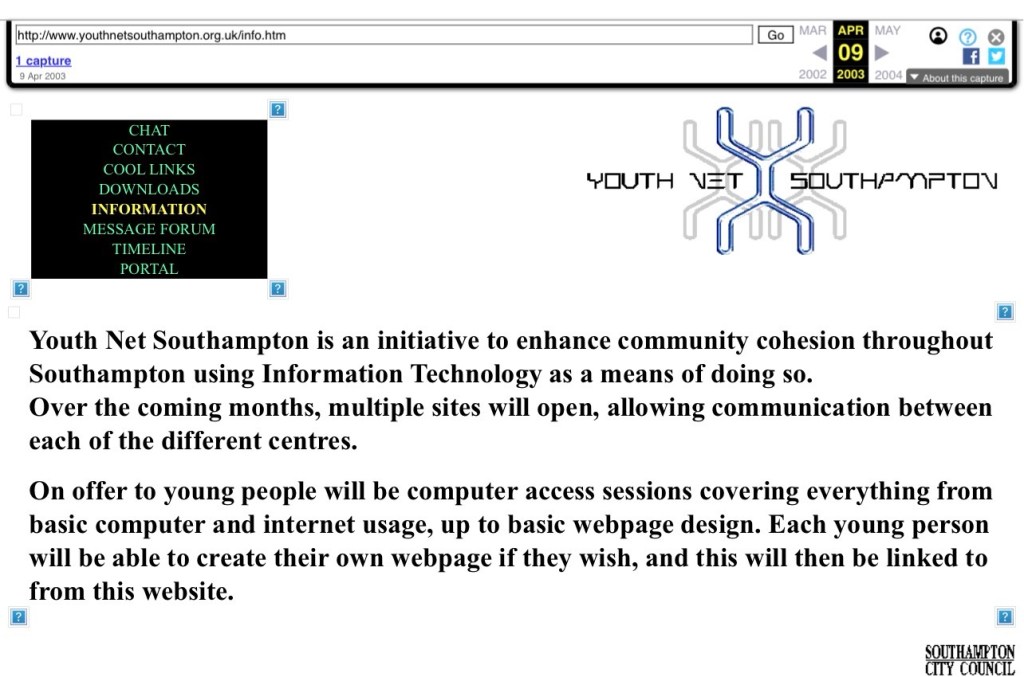
An archived Youthnet information page, captured in April 2003, described the project as an attempt to strengthen community cohesion through information technology. It offered computer-access sessions ranging from basic internet use to introductory webpage design. Young people could also create personal webpages connected to the wider site.
The surviving Youthnet portal connected locations including Ashby, Millbrook, Newtown, Bargate, Thornhill and Woolston youth centres. Elsewhere, the platform contained a Youthnet message board, online polls, comments, local information and an extensive Hype Magazine archive.
Youthnet therefore combined a digital platform with a network of physical places. Access was not treated as a website address alone; it required equipment, buildings and people who could help young users enter and navigate the space.
I remember Youthnet being developed with Simon Whitmore, Charlie Andrews and Mike Banks, while Dale Baldwin and Gary Iles managed much of its day-to-day technical operation. Young people registered through the system to use the internet, which meant the platform functioned partly like an intranet for the city’s youth provision. It provided information and linked different sites, but it also created a route through which young people could become members, publish work and communicate.
A Southampton City Youth Strategy published in 2005 provides further evidence of Youthnet’s role. The strategy records internet access built around five-machine suites in seven informal youth settings. It describes the website as a source of information about youth issues and as a way of gathering young people’s views. It also identifies Hype as a publication involving young people in contribution, design and production, while using placements to develop employment skills.
Access and monitoring
Looking back, the registration system is significant. Youthnet enabled access and made the provision visible and accountable within the service, but registration also made young people visible to the institution through data. Access and monitoring were not separate processes; they arrived together.
It would be too simple to describe this only as surveillance. The system provided a resource that many young people could not otherwise assume. At the same time, it raises questions that have become more pressing as digital systems have expanded: what information someone must provide to receive something, how institutional knowledge is produced, and what happens when a record begins to stand in for the person using the service.
Participation can quickly become something measured through registrations, attendance, survey responses and website hits. Those figures demonstrate reach; they do not necessarily show whether a young person’s contribution affected a decision.
Youthnet taught me that access is never only technical. A computer does not create participation by itself. Young people also need a place they can enter, support they can trust, information they can understand and a meaningful reason to contribute.
The technology now looks modest, but its central questions have not dated. Who has access? Who controls the platform? Who is represented? What happens to the information people contribute? What remains when a short-term programme or funding stream ends?
Hype Magazine and Youthnet would subsequently sit within the wider identity of YouthInc. That later stage made the service’s ambition for youth participation more public, but also exposed the difference between being invited to speak and being able to influence what happened next.
Earlier practice informing YAW · Southampton · 2001–2005.
This post documents work undertaken before YAW was established, but which informs its present thinking and practice.
 YAW
YAW 